Robert P. Boylan, Michael S. Feller and Kenneth O. Huitt are listed on the 8th Air Force wall in Duxford; England as having fallen in the air war in Europe. This is their story and it is dedicated to all of the airmen who participated in that conflict.
Staff Sgt Robert Patrick Boylan flew with the mighty 8th Airforce in the 381st Bomb Group (Heavy), 534th Bomb Squadron and fought as a ball turret gunner on a B17-F Flying Fortresses B17-F 42-29784 Smilin Thru and Flat Foot Foogie 42-29803.

Used with kind permission of Tony Yorba
Robert Boylan and his crewmates took part in the toughest campaign of the greatest air war ever waged and died on the mission which came to be known as Second Schweinfurt or Back Thursday. Here is a close enough color video clip showing a Ball Turret Gunner like Robert P. Boylan in action (Ball Turret Video). The clip is from the excellent film Mephis Belle. The classic 12 O´Clock High and a History Channel Video offer even more general background.
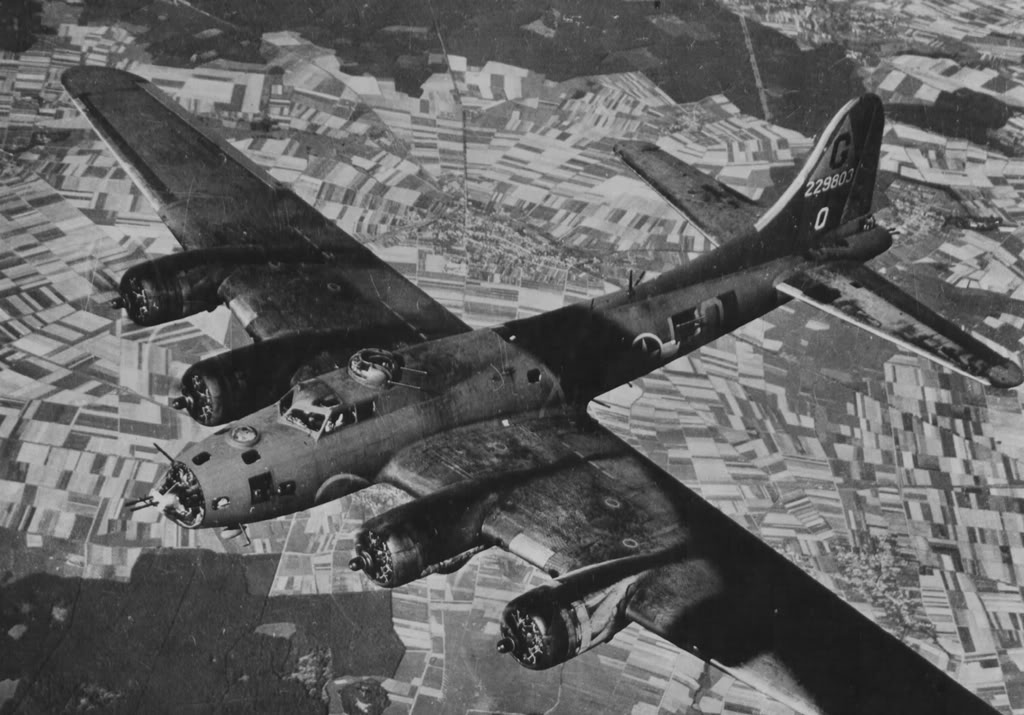
Source: Jack Cook http://www.warbirdinformationexchange.org/phpBB3/viewtopic.php?p=183581
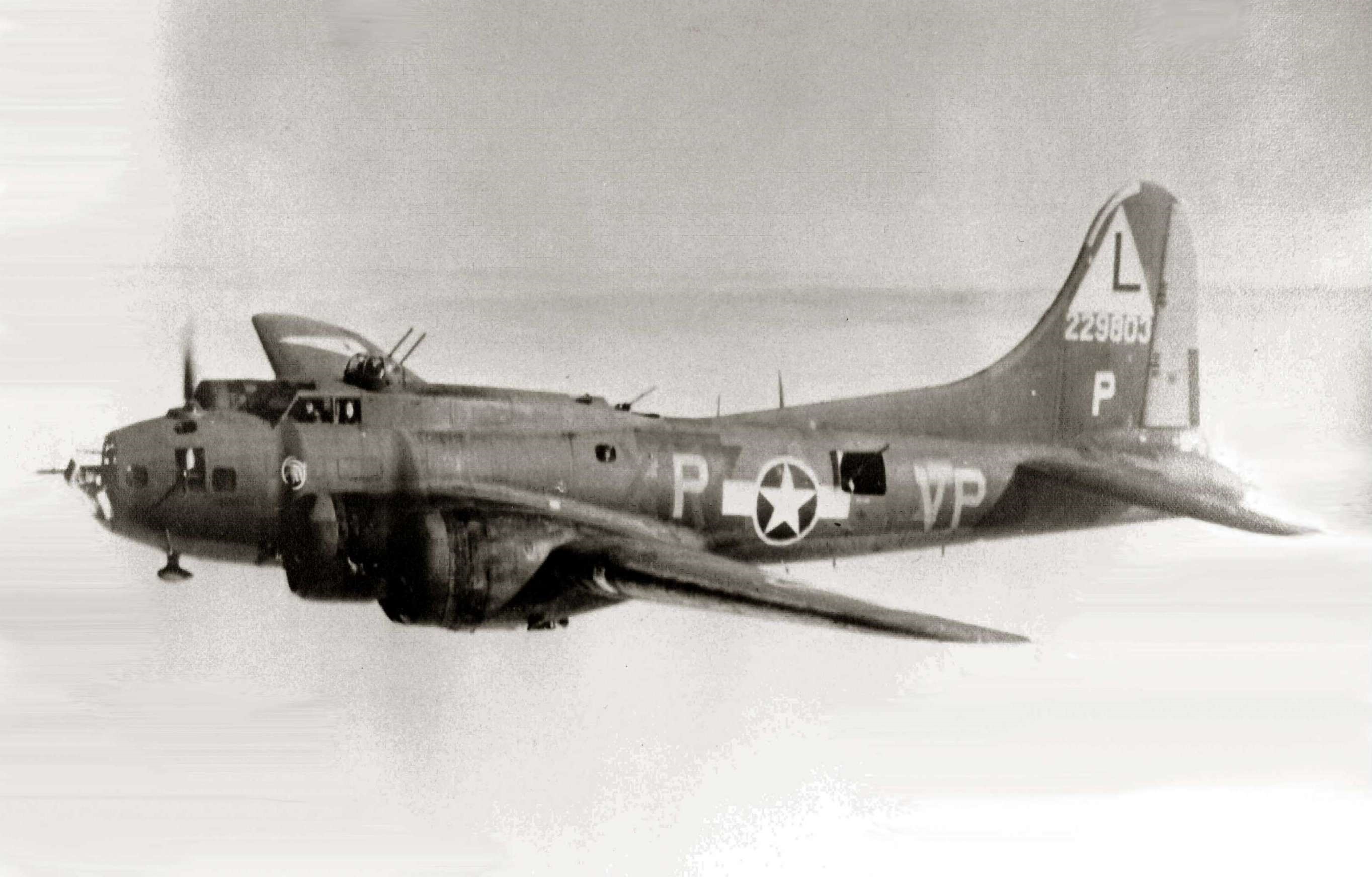
This photo of Flat Foot Floogie 381st BG, 534th BS was taken on Oct 7th 1943 when the aircraft was still with the 305th Bomb Group. There is a picture of the aircraft on pages 100 & 101 of Martin Bowmans, Castles in the Air. The triangle G on the stabilizer was repainted triangle L upon transfer to the 381st. BG.
Here is the story of Clansman and Ball Gunner Staff Sgt. Robert P. Boylan and the rest of the brave young crew of Flat Foot Floogie.
Robert was born on May 14th 1914 in Stark Ohio. When he died in a field in Hausen, near Schweinfurt on October 14th 1943, he was 29 years old. He married Comella Boylan Ratliff, but immediately after a divorce in May 1942, six months after Pearl Harbour, he volunteered to join the USAAF. Being not so very tall (see the photo below), he was selected to perform his duties in the cramped space of a Sperry Ball Turret under the fuelage of the B17. Roberts training as a ball turret gunner commenced at one of the gunnery training bases in the US and occupied him for the second half of 1942. To learn more about what gunnery training was like, see the US Army Air Force Aerial Gunnery Training Film.
After becoming proficient with the 50 cal Brownings, Robert P. Boylan was was assigned as the ball turret gunner in the crew of 2nd Lt Yorba. Here is the crew line-up that flew on Black Thursday.
2nd Lt Bernardo Marcus Gus Yorba (Pilot) Anaheim, California (good looking guy - bottom left of the photo below)
B17 Aircraft Check B17 TAKEOFF-Pilot Training Film Part 1 & Part II Cartoon Training for B17 Pilots
Gordon Chili Childers O-802250 (Co-Pilot) Crawfordsville, Linn, Oregon
Wilbur Willi Gillis Roberson (Bombardier) Coeburn, Virginia Summit, Ohio
Martin „Marty Mordecai Dall (Navigator) New York
Edgar H. Gracey (Radio Operator) Philadelphia, Pennsylvania
Johnny N. Johnson (Rear Gunner) North Kansas City, Missouri Rear Gunner Training Film
Kenneth O. Huitt (Waist Gunner) St. Louis, Missouri - last minute fill-in crew not in photo below
Michael S. Feller (Waist Gunner) Kings, New York - last minute fill-in crew not in photo below
William Gorgone (Engineer and Upper Gunner) Middlesex, Massachussetts
Robert Patrick Boylan (Ball Turret Gunner) Stark, Ohio US Army Air Force Gunnery Training Film
Flight Engineer & Top Turret Waist Gunner Waist Gunner Ball Turret Gunner Rear Gunner
Sgt. William Gorgone Sgt. Carter* Sgt. Dunn* Robert Patrick Boylan Johnny Johnson
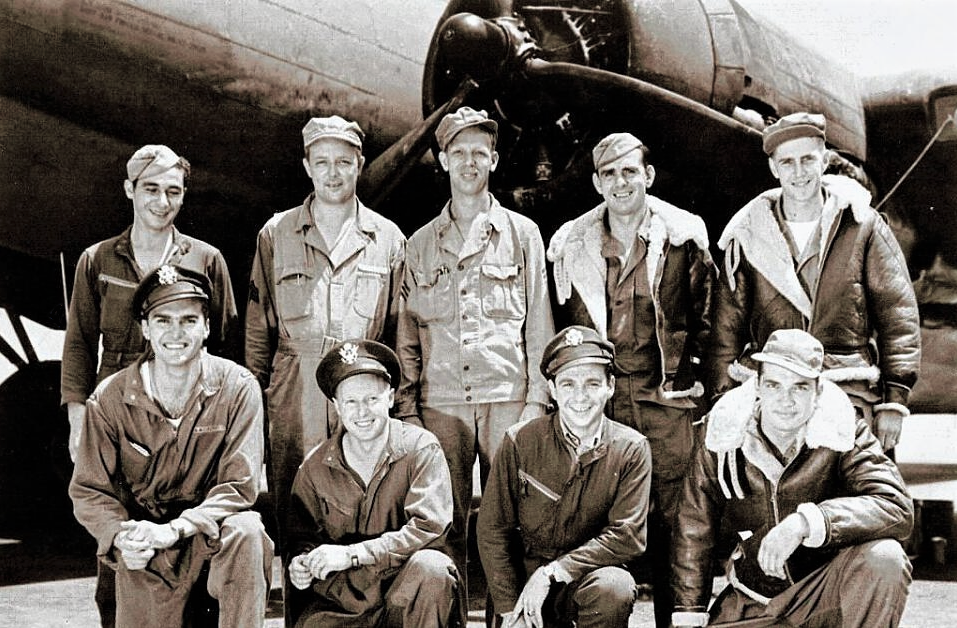
Pilot Lt Bernardo Yorba, Co-Pilot Gordon Childers, Navigator Martin Dall Bombardier Wilbur Roberson
Crew photo used with kind permission of Tony Yorba
* For some reason the waist gunners were assigned to a different aircraft on Oct 14. They were replaced by Sgts Huitt and Feller.
The 381st BG was formed on January 1st 1943 under the stern but fair command of Lt. Col. Nazzaro. Lt. Col. Fiegel.was the Air Executive and the Group Operations Officer was Major Hall. The 534th Bombardment Squadron was led by Capt. Dave Kunkel. His B17 was called Whale Tail II.
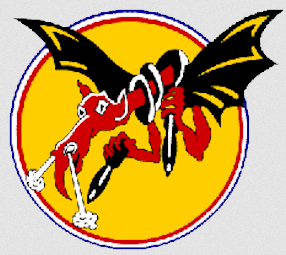
WWII Insignia of the 381st BG, 534th Bombardment Squadron
At first the 381st was stationed in cold dry winter town of Pyote Texas. At that time, Pyote only had 75 residents. Few creature comforts were to be found there except a couple of steak houses, one Hill Billy radio station and some trailers inhabited by very friendly ladies. Coyotes howled at night and 40 MPH dust storms regularly hit Pyote. Robert was surely happy to leave the place.
Busy with training, Robert probably did not read the Casablanca Directive which was approved by the allies on 21 January 1943: Your primary object will be the progressive destruction and dislocation of the German military, industrial, and economic system, and the undermining of the morale of the German people to a point where their capacity for armed resistance is fatally weakened. But sooner or later the officers of the 381st must have heard about that directive. It set the course for the whole 8th Air Force for the next two years.
Living conditions improved when the 381st moved to Pueblo Colorado on the 4th of April 1943. The base had full facilities and the proper town of Pueblo was quite close. The men noted that recognition of Japanese aircraft was quietly dropped from the classes, while training about European conditions continued.
Two dogs accompanied the 381st Bomb Group to Europe: Nick and Meatball. Physical exercises and inoculations rounded out the stay in Pueblo. Lt. Yorba (and his wife) named their B17-F (Boeing production block B70 42-29784) Smilin Thru after their popular song of the day.
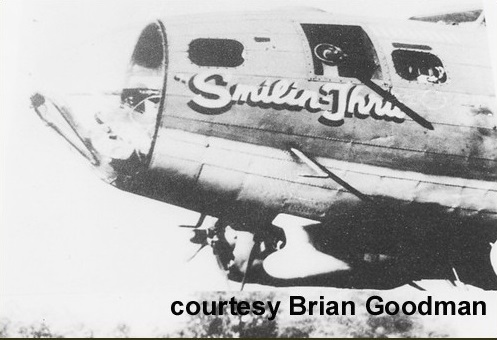
The Overseas Movement Order arrived on the 2nd of May and the first B17 of the 381st BG left Pueblo on the 5th of May. The route initially led westward to Salinas California for a 14 day stay where the airmen received the good equipment and clothing. Then Lt Yorba flew the crew via Detroit, Michigan and Bangor Maine to Gander Newfoundland. One day in Mid May, Robert Boylan watched America recede in the West as Lt Yorba set course over the Atlantic for the 14 hour flight over Greenland and Iceland to Prestwick, Scotland. Their first airbase was Bovingdon near London. On June 6th Col Nazzaro landed his B17 at Ridgewell (20 miles from Cambridge). Ridgewell was to be home for the 381st for the duration of WW2, but Robert P. Boylan only stayed there for 5 months.
In Ridgewell they had a large number of acclimatization and familiarization flights. Intensive training was continued to prepare for combat conditions. (The USAAF hat only 1 year to build up to combat strength, while the Luftwaffe had been preparing for 10 years.)
Later ferry and replacement crews, brought the upgraded and safer B17-Gs (with highly effective chin turret guns). The highly desirable B17-Gs were usually immediately taken away from the ferry crews when they arrived by the old guys and the noobs were forced to fly battle-weary B17-F aircraft in the dangerous Tail End Charly slot of formation, where they were quite often promptly shot down on their first mission.
Because everybody still had B17-Fs in 1943, Lt. Yorba, Robert Boylan and the rest of the crew were initially permitted to keep the original Fortress Smilin Thru that they ferried over. There were 800 B-17-Fs in England in September 1943.
A chilling and horrible incident occured at Ridgewell at 11:00 AM on June 23 1943 an officer and 22 men of the 381st were loading eleven 300 lb bombs (with the fuzes installed) on B17 42-30024 when a bomb was most likely dropped. It went off and 45 seconds later it triggered the other 10 bombs so 3000 lbs of HE (high explosives) causing a great explosion when the bombs went off together, pulverizing the plane and the 23 men and throwing bits and pieces over a wide radius. We can assume that Robert heard the explosion, saw the smoking ruins in the crater and shared in the horror at the disaster. Perhaps he even knew the men.
Robert did not participate in the complicated shuttle raid targeting the Messerschmitt aircraft plant in Regensburg and the ball bearing sites in Schweinfurt, because Smilin Thru was not yet fully operational in August 1943. However, having been in the unit at the time he must have been fully aware of the risks: One in five crewmen died: The first Schweinfurt raid in August 1943 had a 19% aircraft loss rate (60 planes were downed, and 100 sustained damage). What kind of thoughts did Robert have after the Ridgewell explosion in June and the debacle of the first Schweinfurt mission in August?
Due to an administrative reshuffle to replace aircraft losses, the 381st received a B17-F named Flat Foot Foogie 42-29803 from the the 95th BG 334th BS BG-D 8 on the 11th of September. The fresh combat crew of Lt. Yorba including Robert Boylan took over this aircraft and were integrated in the active 534 BS which was part of the 1st Division - identified by the large triangle painted on the stabilizer. The photo above shows that up to October 7th the aircraft was marked triangle G. Between October 7th and October 14th the stabilizer was repainted triangle L as in the picture below. The L in the triangle was reserved for the 381st BG. In 1944 the radio call sign of the 381st was Midgit.
Flat Foot Floogie (you can see the pilot Bernardo Yorba looking out) with the L marking of the 381st BG. Used with kind permission of Tony Yorba
Mission Nr. 1: September 15th 1943 Smilin Thru Romilly-Sur-Seine, France
Robert Boylans first mission was a shallow penetration to the Airfield at Romilly-Sur-Seine, France, an important German reserve aircraft base. This was a small raid with only 17 bombers. The Point Blank Directive targeted German air bases and factories in France and Germany. Returning in one piece from the first combat mission was a great confidence builder for Lt. Yorbas crew. All of that training was beginning to pay off.
Mission Nr. 2: September 26th 1943 Smilin Thru Meulan Les Murreau, France
His second combat mission was to destroy an aircraft assembly plant at Meulan Les Mureau, France, but the whole group was recalled for some reason. Luckily the mission counted because they had flown far enough.
Mission Nr. 3: October 2nd 1943 Smilin Thru Emden
Robert Boylans first trip to Germany was to bomb the port and dock areas of Emden, in the north of Germany. The 318th suffered no losses.
Mission Nr. 4: October 4th 1943 Smilin Thru Frankfurt
An old joke in the 60s was about the commercial airline pilot who upon landing at Frankfurt was bawled out by the tower for using the wrong ramp: Why do you taxi like zat? Haff you never been hier bevor? The old pilot replies: Sure I flew to Frankfurt several times in the past, but we never landed here until today...
Frankfurt was no walk in the park for the crew of Smilin Thru. On the way to the railroad marshalling yards in the city of Frankfurt/Main, Germany, the Luftwaffe defended this large German financial center in force. A nasty air battle ensued - in 1943 the Luftwaffe still had many very experienced pilots and they attacked aggressively making several passes at the formation. Robert Boylan in the cramped ball turret could see the winking of the machine guns of the attacking enemy fighters. He rotated the turret and put out several bursts with his twin 50 caliber Browning machine guns. Aiming at these targets was very difficult as they zoomed past at high speed, but he lead them in the sight target sight them as he had been trained to do. All that practice with deflection shooting at moving targets in Payote Texas came in handy in this moment.
Here is a color clip from Memphis Belle showing a similar ball turret action (Must See!).
During this encounter, Smilin Thru was hit several times and was very badly damaged. Somehow Bernardo and Gordon managed to limp their B17 home to England. Luckily all of the aircraft of 534th Squadron made it back to base. Often a medicinal brandy was administered after a tough mission or when the ship got shot up. After the mission the crew were debriefed. It was important to find witnesses who corroborated claims of hits. A witness must have been found this time, because Robert Boylan was officially credited with destroying an enemy aircraft. The damage to Smilin Thru made their own B17 unserviceable for the next 10 days.
Mission Nr. 5 October 9th 1943 Flat Foot Floogie? Anklam
Back over Germany again, the mission this time was to bomb the Arado Aircraft Components factory located just off the center of the town of Anklam, Germany. This was to be one of the deepest penetrations of Germany that had been attempted so far - a 1500 mile flight along the coast to the north. Perhaps Robert, like most of the other crews packed thousands of extra rounds ammunition, by making deals with their ground crews.
Smilin Thru remained out of service, so the crew were assigned a replacement ship.Flat Foot Floogie was originally from the 305th Bomb Group. It had been shifted to the 533rd squadron and was now reassigned to Lt Yorba in the 534th. Either the photo above was taken before the final reshuffle or the ground crews did not have time to repaint the squadron logo. Anyhow you can still see the logo of the 533rd on Flat Foot Floogie just below the pilot in the picture above.
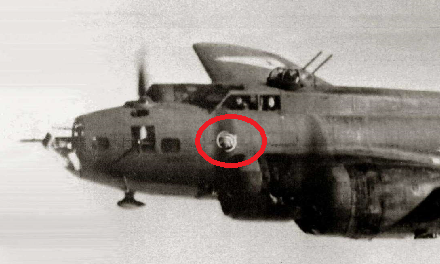
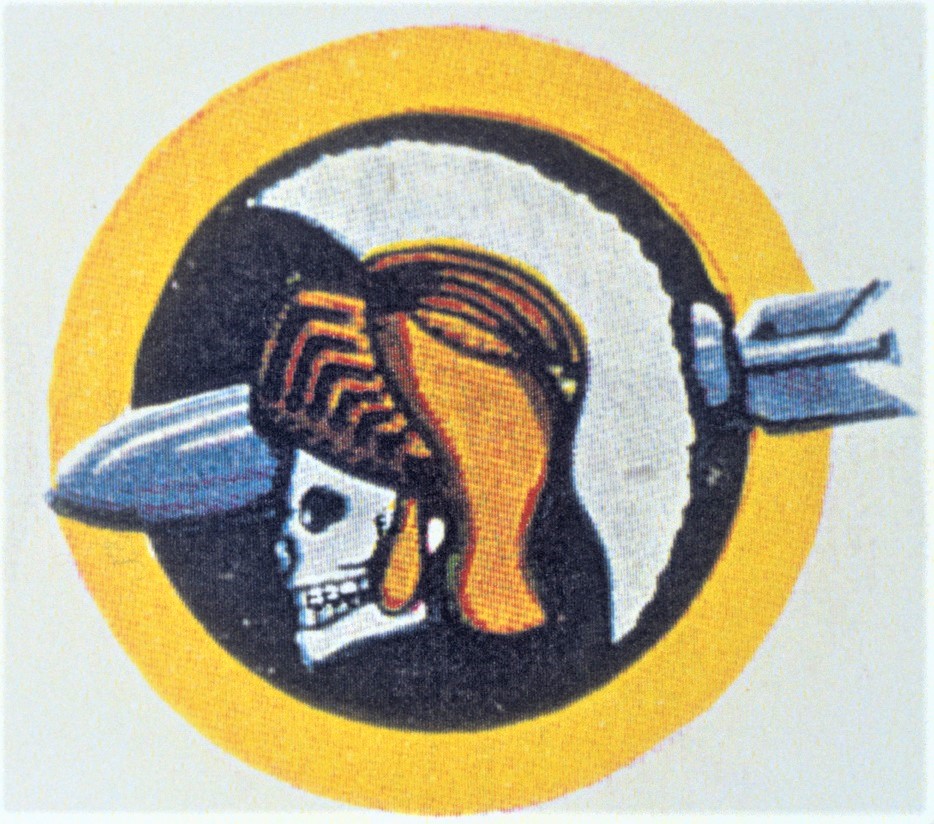
This mission did not go so well. The Luftwaffe made several appearances and shot down a number of aircraft resulting in 34 MIAs (Missing In Action). Six more of the original 40 crews forming the 381st had been lost this week bringing losses close to 50% in total. Worse yet, the bombing accuracy on the Arado plant was judged to be poor, but Lt. Yorba brought his aircraft and crew safely back to Ridgewell and the mission counted.
Mission Abort October 10th 1943 Flat Foot Floogie? Münster
The target was to be a center for rail and waterway communications in Munster, Germany, but Lt. Yorba had to abort the mission for technical reasons, so the mission did not count for him or for Robert Boylan.
Mission Nr. 6 October 14th 1943 Flat Foot Floogie S E C O N D S C H W E I N F U R T
The target was Schweinfurt, literally Pig-Ford over the small Main River shallows, Germany. Click here to see the Schweinfurt background video
The USAAF strategists at Pine Hill in England had determined that ball bearings were a core component of most of the German war machines. German trucks, tanks, artillery, submarines and aircraft all used ball bearings and were rather unpopular with the allies, so it was decided to knock out the manufacturing centers. The very best and largest ball bearing manufacturers were situated in Schweinfurt, in the Franconian district of northern Bavaria. 43% of the total German ball bearing production came from Schweinfurt. The problem was that the Germans had identified the allied strategy and decided to defend Schweinfurt well with both Luftwaffe fighters and Flak guns. Wikipedia writes that the ball bearing strategy was a mistake because the Germans could disburse manufacturing and had second sources: Wikipedia on Second Schweinfurt (Generally the later oil strategy was deemed much more effective, because chemical plants are much more difficult to disburse, but this was still 1943.)
This was the second time that the eighth Airforce set out to bomb the ball bearing factories at Schweinfurt and the Germans were ready and waiting. Again.
Smilin Thru was finally repaired and returned to service on this day, but it was loaned or transferred to Lt. Johnson of the 545th BS 384th BG. (Luckily the Johnson crew made it home from Schweinfurt. Due to battle damage, lack of fuel or bad visibility they had to parachute when the made it back to England, leaving Smilin Thru - the plane ferried from the US to England by the Yorba crew - to crash somewhere.)
The awful First Schweinfurt mission of August had been talked about a lot in Ridgewell. One of the scheduled flight crews was unavailable for one reason or another (See the 12 Oclock High motivational speech by Gregory Peck). At the last minute Lt. Yorba and his crew were selected at the last minute to fill in. Their plane on the October 14th mission to Schweinfurt was Flat Foot Floogie 42-29803.
As was usual for every mission, the officers and men were literally awakened at Oh dark thirty. That is military language for the middle of the night. After a quick breakfast of square eggs (dehydrated powdered eggs). The officers went to the briefing in the Quonsett hut: The target for today is Schweinfurt. 30 minutes into this TARGET FOR TODAY video you have almost the same scene. The records state that as the target Schweinfurt was mentioned, it: shocked the crews into complete silence. (See Ridgewells Flying Fortresses by Ron Mackay, page 59. Lt Yorba is mentioned.)
For some reason the waist gunners Carter and Dunn were assigned to another aircraft on this day. A well established team of pinch-hitters Feller and Huitt were assigned to Lt Yorba. These waist gunners did not have a permanent crew and filled in on different planes as needed, but they were both experienced and team-oriented. The enlisted men, including Robert Boylan, donned their heated lambskin suits and checked the equipment. They were trucked out to the hardstand where Flat Foot Floogie was gassed and bombed up by the ground crew.
The pilots began their preflight checks and after some waiting the signal for engine start was given. After warm up and taxing in the waddling fashion of the B17 on the ground, they took off very heavy and started the climb-out. Take off of a similar Bomb Group in 1943
The climb continued on instruments through the ever-present English cloud cover with pilots on constant look out to avoid collisions with other B17s. Grouping up on the radio bunchers, Flat Foot Floogie was late getting into formation on their 6th mission and did not link up with the 534th at the right time and place, so they flew with another squadron that they found instead. Then they met up with the escort fighters and crossed the English Channel. All too soon, over France, the little friends had to turn around and fly for home due to lack of fuel and range. From now on the B17s were without fighter cover as they flew on to Germany!
The Luftwaffe was charged with shooting down the allied bombers. The proud Reichs Air Minister Goering had said in a radio interview at the outbreak of the war: "Wenn auch nur ein feindliches Flugzeug unser Reichsgebiet ueberfliegt, will ich Meier heißen!- Should only a single enemy aircraft fly over the Reich, I want to be called Meier! The RAF started night-bombing Berlin shortly therafter. So on the 25th of August 1940 during the battle of Britain and Goering became Meier.
The Luftwaffe had indeed lost a good number of experienced fighter pilots in the Battle of Britain, but in 1943 there were still plenty of good flyers in the Luftwaffe - enough to shoot lots of holes in the B17s. After the fighter cover turned back, the 381st Bomb Group had to fight the Luftwaffe in a 3 hour long running battle all the way to Schweinfurt and back. Suggested reading: Wrong Place Wrong Time by George C. Kuhl (participant in the 305th BG).
As Flat Foot Floogie was nearing Schweinfurt following a heading of 050 degrees (Northeast), a Luftwaffe Bf 109G-6 fighter flown by Uffz (Sergeant) Robert Meyer-Ahrend attacked them. The Messerschmitt Bf 109G model was popular in the Luftwaffe (even though it was difficult to land) and was fondly called Gustav by German pilots. Ahrend shot out an engine and Lt Yorba had to shut down a second damaged one shortly thereafter, but the tough and reliable B17-F kept on flying for just a little longer. Then Ahrend was forced to leave the crippled B17 because it had entered Schweinfurts dangerous Flak zone. It is highly unlikely that Uffz Robert Meyer-Ahrend flew his Bf 109G-6 very far through the shield of exploding Flak shells protecting Schweinfurt.
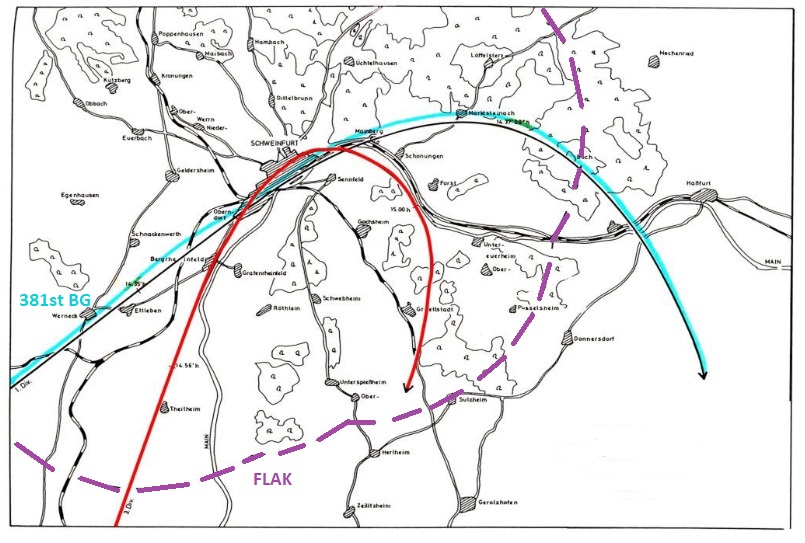
The attack course of the 381st was 050 degrees. Source unknown. No copyright infringement intended.
The second ring of defence around Schweinfurt was a large number of the much-feared 88 cannon, better known as Ack Ack from Anti Aircraft or Flak (German for FLugAbwehrKanone). These cannons could be radar controlled, so the B17s preferred to zig-zag to avoid the highly dangerous, exploding 88mm shells. For the final part of the bombing run, the planes had to fly straight and level in order to permit the lead bombardier to adjust the top-secret Norden bombsight. Flying in close formation, the B17s were like sitting ducks for the solders manning the Flak cannons. During debriefings, flight crew often spoke of black puffs of smoke that were so thick you could get out and walk on them.
Flat Foot Floogie, Robert Boylan and the rest of the crew now had the Flak all to themselves. Their wounded airplane, still chugging along on two engines, left formation as Lt. Yorba and Lt. Childers fought with the unresponsive controls. Robert had the best view of all of the Flak from the windows of his Sperry ball turret. Each location with a box around the name is one of the feared 88 mm Flak installations.
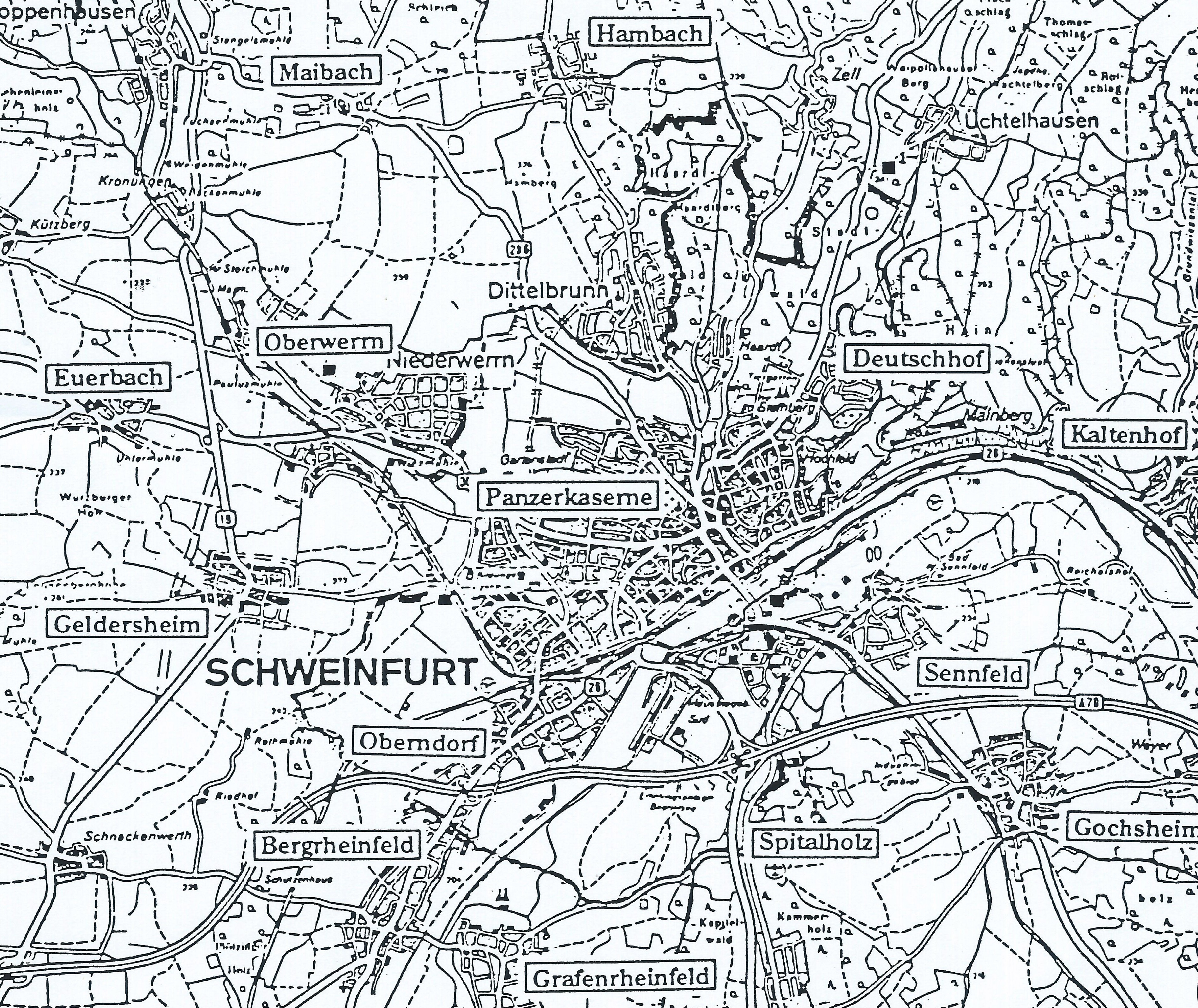
Map of heavy 88 mm Flak around Schweinfurt. Each box indicates a heavy Flak battery. Source unknown. No copyright infringement intended.
Lt Yorba and Bombardier Wilbur Roberson managed to drop the bombs somewhere over Schweinfurt, but 42-29803 had already been badly damaged by Uffz Robert Meyer -Ahrends Bf 109G-6 attack (he claimed a kill) and things were looking grim and about to get worse.
Right after bombs away over Schweinfurt Flat Foot Floogie was suddenly hit very hard in the rear of the plane by Flak. Two engines were out by now. The tail section and perhaps also the right fuselage wing-root were so severely damaged by the exploding Flak shell that that Lt. Yorba knew that he had no chance of flying home or even keeping control of Flat Foot Floogie any longer. Sitting on the right side, Lt. Childers may have seen that the right wing root was bending visibly and making creaking noises and the whole right wing may have been loosely flapping and oscillating like it was just about to break off, but the resilient B17 kept on flying for vital seconds. It got them away from the built-up city of Schweinfurt and over the nearby rural village of Sennfeld. In this state of dire emergency, things started to happen even faster than before:
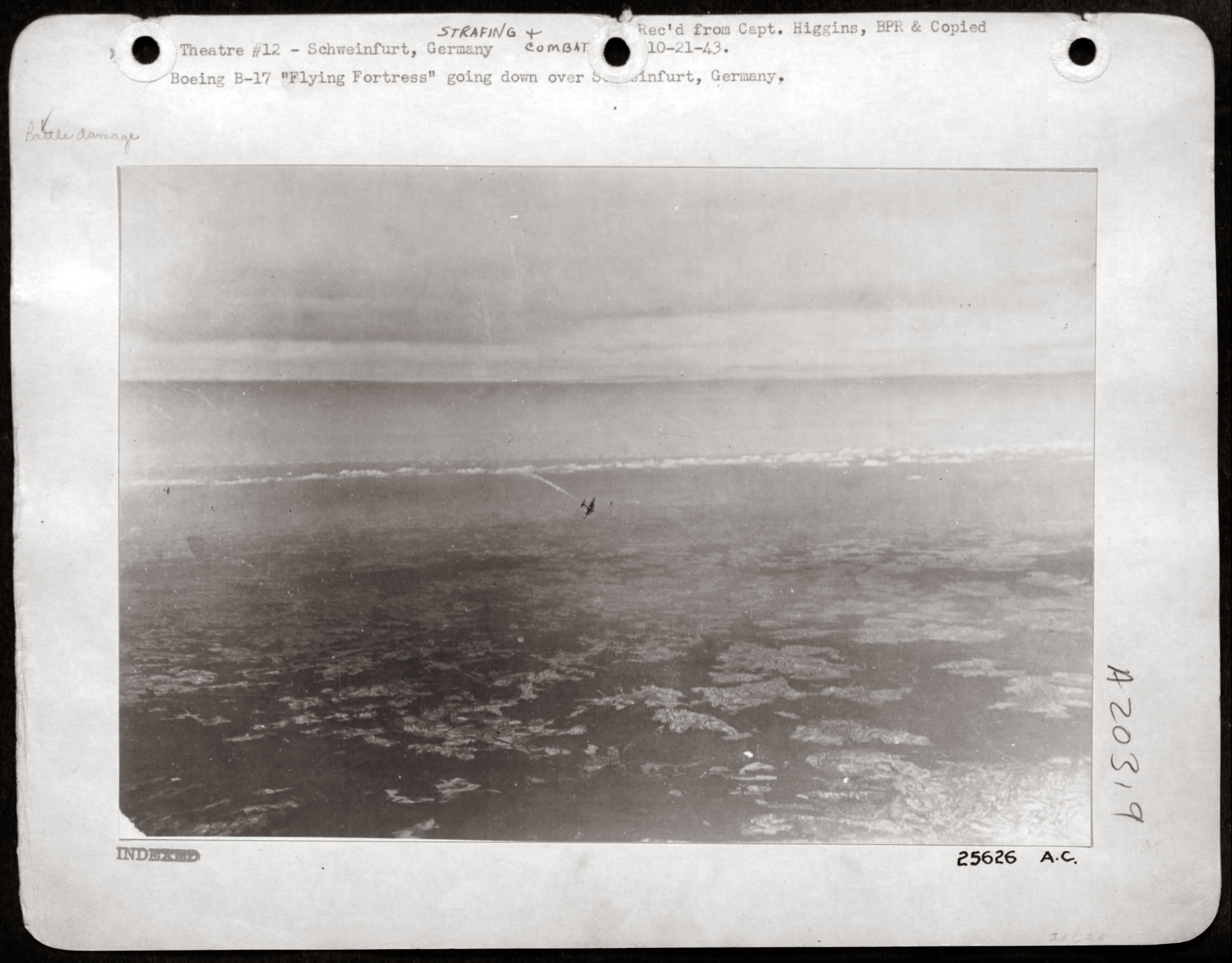
US Army Aircorps photo of a B17 going down over Schweinfurt
Note 1 The aircraft is not Flat Foot Floogie - this photo is from the first Schweinfurt mission in August.
Note 2 You can see a tiny German fighter on the far left under the cloud, chasing the B17 - there were no American fighters there in 1943!
As perhaps Lt. Childers was informing Gus Yorba about the condition of the right wing, the ball turret gunner, Sgt Robert Boylan called over the intercom that he had been hit badly by shrapnel from the exploding tail Flak hit. Lt Yorba warned the crew that they would have to bail out very, very soon. According to Tony Yorba his father said that side gunners Huitt and Feller began to extract Robert from his ball turret. (According the American War Museum in Britain it was S/Sgt Gracey (Radio operator) who assisted Robert Boylan out of the ball and he did not appear to be wounded.) This took vital seconds because getting in and out of the ball turret when dressed in a thick electric flight suit was normally a hassle and Robert Boylan was badly wounded according to Bernardo Yorba. The tough B17 gave them those seconds. Feller and Huitt planned on taking the wounded Sgt. Boylan forward to the navigators little cubicle - which was often used as the onboard first aid station. While they were walking about and caring for their wounded crewmate Sgt Boylan, Huitt and Feller had to disconnect their headsets from the planes intercom system. They probably did not hear Lt. Yorba gave the final order to bail out. They may have been busy mounting a parachute to Robert Boylan. Bernardo Yorba sent Flight Engineer, Sgt William Gorgone back to make sure that the waist gunners jumped right away.
To get to the rear of the fuselage Gorgone had to cross a tiny aluminum spar walkway called the catwalk. While he was attempting this feat, the vibrations of the stricken aircraft or the flapping right wing caused Gorgone to slip off the catwalk and fall out the still open bomb bay doors. He probably bumped his head while exiting and was therefor unable to open his chute. Flat Foot Floogie still had some altitude over Sennfeld at this point.
Sgt. Gorgone hit the roof of a small barn behind a house in the Schweizer Street of Sennfeld and died instantly. He was initially buried in Sennfeld cemetary by the Lutheran minister as an unknown aviator. The irregularity on the right side of the photo shows where Gorgone hit the barn. The widow living there had a tough time paying for repairs to the barn from her pension and did not receive any compensation.
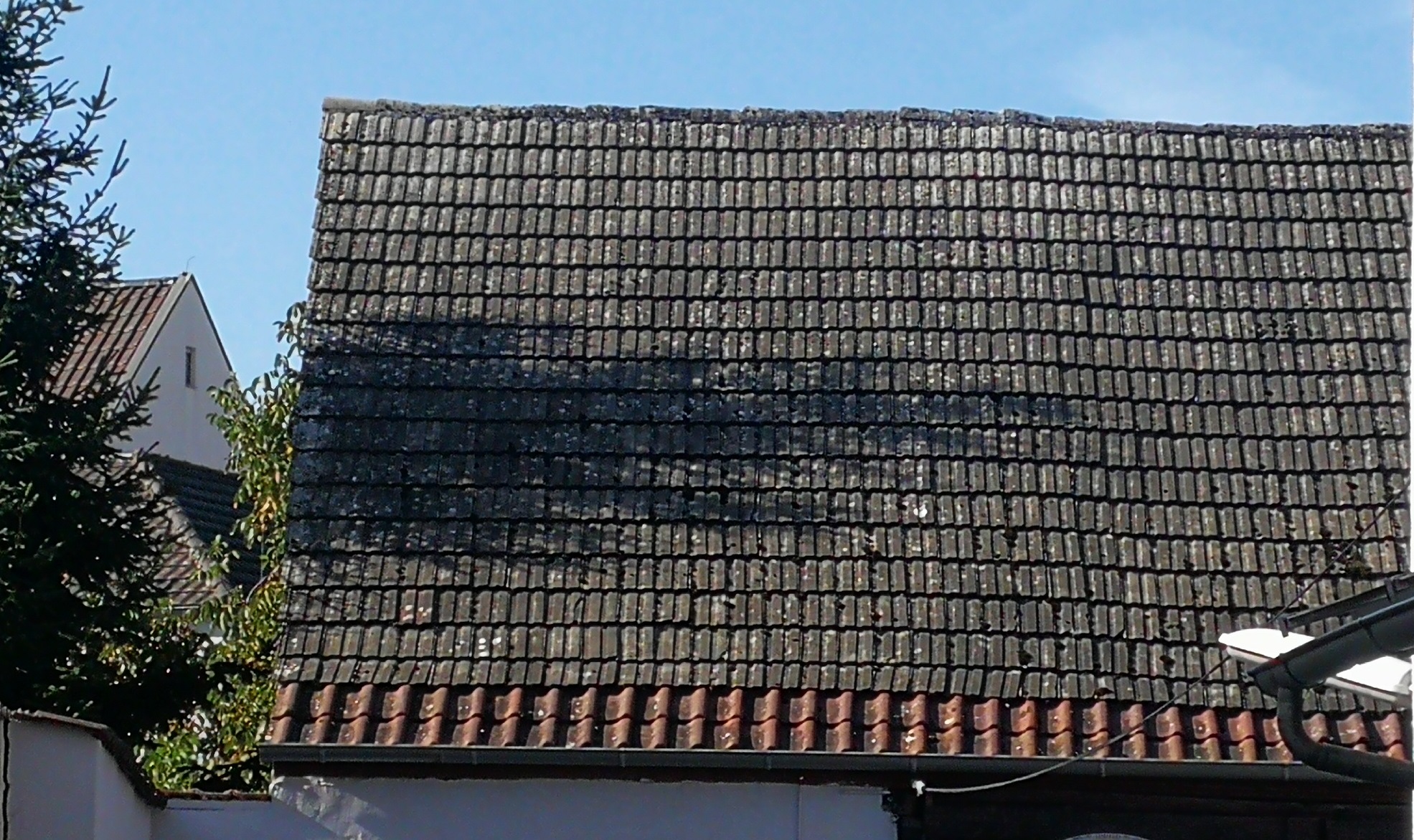
The barn in Schweizer Str, Sennfeld that Sgt Gorgone fell on. Photo Peter Boylan Oct 14th 2019
Seconds later, six crewmen exited the disintegrating aircraft, hit the silk and parachuted to the relative safety of the Germany countryside. Gus Yorba and Chilli Childers landed close to an isolated building, a former Chalet now called Bad Sennfeld Bar Restaurant. There was very little cover: they hid in a ditch, but many people harvesting the fields had observed them coming down slowly about 500 meters east of the village of Sennfeld. Gus Yorba was trying to be invisible in the ditch when he heard the classic Vor you ze war iss over ! uttered by an armed German soldier or policeman.
Crewmen Gracey, Dall Johnson and Robertson landed about 200 meters away. They ran about 150 meters into a tiny patch of forest called Hohe Lohe and hid, hoping to escape and evade.

2019 photo of a ditch behind Bad Sennfeld Chalet by Peter Boylan. The woods of Hohe Lohe are in the upper right.
The paved road points to the houses of the village of Schonungen/Hausen (on the other side of the Main River valley)
The tiny Hohe Lohe forest was quickly surrounded and searched by the local militia and police and the four remaining crewmen were rounded up. The prisoners were taken to and interrogated in a nearby Chalet called Bad Sennfeld. In this they were lucky, because later in the war after most Germans had lost a relative and fanatical party members had whipped up emotions on the home front to a frenzy, prisoners were occasionally lynched by irate civilians or even by soldiers.

The Chalet Bad Sennfeld. Photo Peter Boylan Oct 14th 2019
While the waist gunners Feller and Huitt were still trying to get a parachute on their crewmember Robert Boylan with complete disregard for their own safety, Franziska Endres (now Weissenberger) was helping her parents with the beet harvest. Their loaded wagon, pulled by their cows, was standing in front of the beet cellar just beyond their house in the village of Hausen. The family was just about to unload the beets when the alarm alerted them of an impending air raid. Her father suggested, they could go ahead and put the beets into the cellar since the alarm was surely meant for Schweinfurt and besides, they were immediately in front of their cellar, should they need shelter. He unhitched the cows and led them about 50 m downhill to the pasture, for grazing.
Shortly thereafter Franziska observed the sun reflecting off of several olive drab shining air planes in the clear blue sky, coming from the direction of Schweinfurt. She heard and saw numerous small puffs of smoke near the planes from the exploding defensive Flak shells. One of the planes near the rear of the formation was hit and exploded. (Perhaps this was an optical illusion and the pre-damaged flapping right wing came off by itself at this moment, or perhaps Flat Foot Floogie was indeed hit a second time in the wing root by flak!) Large and small wreck pieces of the aircraft flew in all directions, so she then stepped into the family beet storage cellar, which doubled as a bomb shelter, but she continued to watch the scenario from the entrance. Amongst the twirling, falling wreckage she distinctly noted two enemy soldiers, descending slowly under their parachutes.
Franziska was worried about their cows because one wing (the right side, we believe), motors already missing, landed only about 100 m away from her on Farmer Basel's pasture. The rest of the plane appeared to come down near the edge of town but luckily missed it and hit the hill side at the Full's Schindesel property. The two parachutists that she had in view continued to descend slowly and landed about 1 km away, just over the Main River in the fields of Sennfeld - just as described in the photos above.
Franziska was 16 at the time of the crash. She related her eye witness account of the crash of Flat Foot Floogie on Oct. 14 1943 to Mr. Warren-Walker on October 22nd 2015 in great detail - as if it had happened just yesterday!
INSERT Map of the last 3 minutes
The position of Gorgones barn roof in Sennfeld and the location where the parachutes landed at Chalet Bad Sennfeld can be used to plot the remaining track of Flat Foot Floogie across the Main River to the crash site near the village of Hausen.
The total time between the flak hit at 14:39 at 15.000 ft of altitude and the crash of the large piece of plane seen in the picture below at 14:42 was about 3 minutes. After the wing came off, the rest of the plane whirled around and autogyrating like a maple seed copter falling from a tree. The centrifugal force made bailing out impossible for any one still in the plane, so Boylan, Huitt and Feller were found crushed unter the rear fusellage of Flat Foot Floogie , which fell on the Schind-Esel (= hard-working donkey) field belonging to the Full family to the north-east of Hausen.
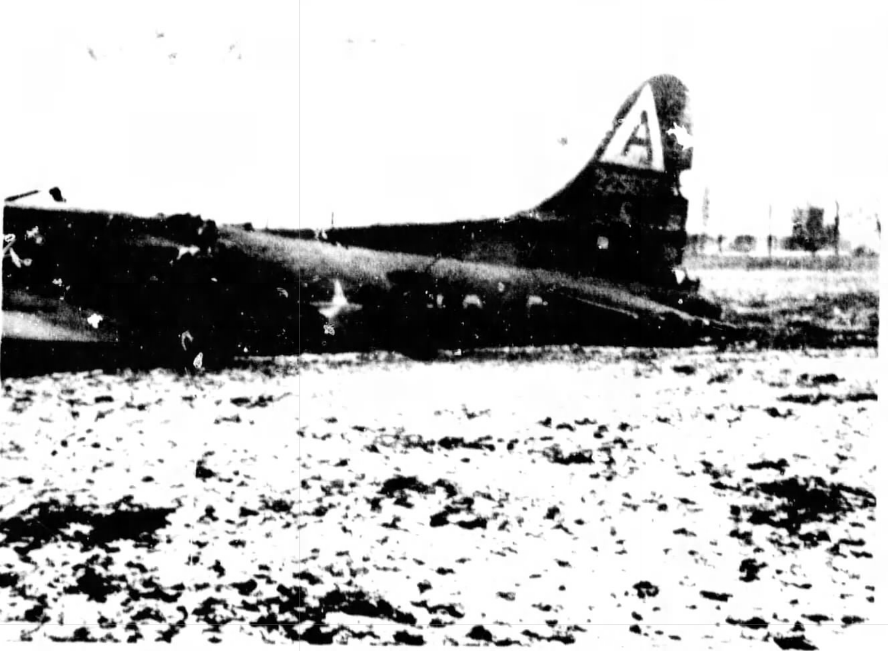
A crashed B17 of the 91st BG
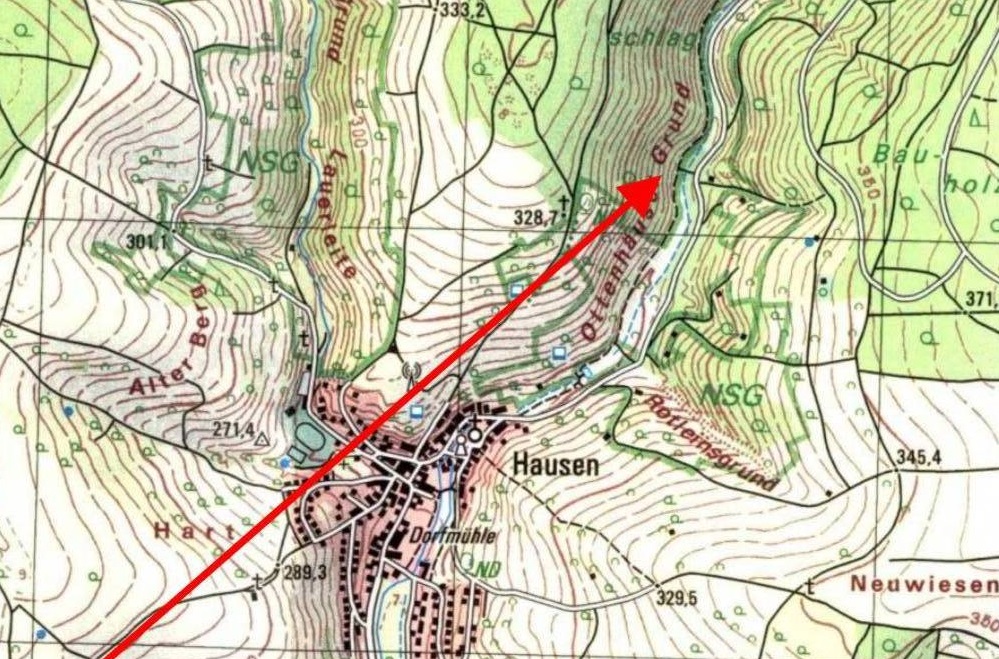
The crash site and debris field of Flat Foot Floogie at Hausen, 5 km NE of Schweinfurt,
Source unknown - no copyright infringement intended
Robert Boylans B17-F 42-29803 was reported by other USAAF aircraft as going down after crossing the target. Uffz Robert Meyer-Ahrend flying a Bf 109G-6 of JG 3/8 claimed the destruction of Flat Foot Floogie at Hausen, 5 km NE of Schweinfurt, Germany Oct 14, 1943 after he landed. Results: 4 KIA, 6 POW. The USAAF MACR (Missing Air Crew Report) 1037 can be found here:
After interrogation the surviving crew of Flat Foot Foogie were relocated to POW camps. If you have seen The Great Escape, or Hogans Heros then you know that the Luftwaffe was in charge of the internment camps (not the Gestapo) and that, while being a POW in a Stalag was no holiday, other prisoners in Germany or the pacific region were much worse off.
Lt. Yorba, Childers and Gracey were initially sent to Stalag Luft 3, far off to the far east of Germany (Sagan-Schlesien is now in Poland) but were later moved back to Nürnberg -Langwasser, quite close to Schweinfurt.
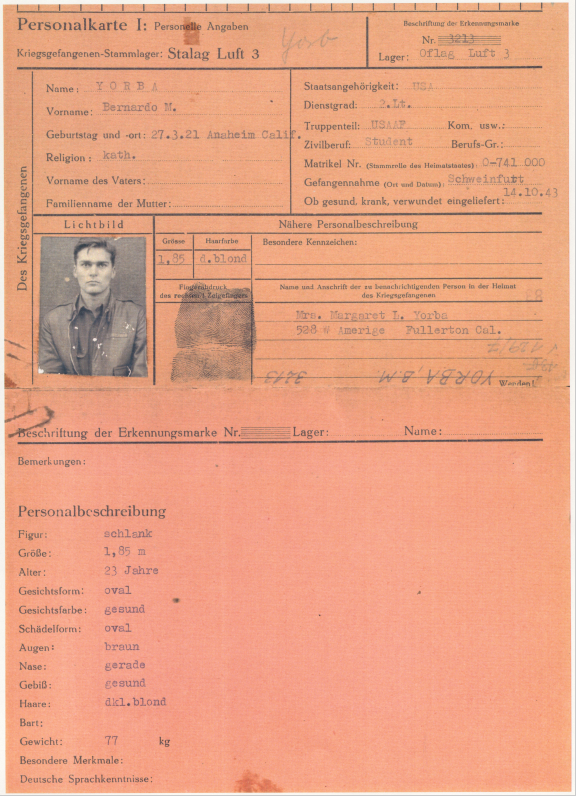
Bernardo Yorbas German Prisoner of War (POW) Identity Card
Typed on the same fateful day October 14th 1943, it lists his profession as student and claims he was 23, (but he must have been 22 in 43).
Used with kind permission of Tony Yorba
Dall and Roberson enjoyed the comforts of Stalag Luft 1 Barth-Vogelsang in Prussia. Johnson initially drew Stalag Luft 4 Gross-Tychow (formerly Heydekrug) Pomerania in Prussia. As the Russians advanced, he was moved to Wobbelin near Ludwigslust and / or to Usedom near Savenmunde. All of the surviving crew were repatriated to the US after their liberation.
According to Norbert Vollmer, the body of Robert Patrick Boylan was identified by his dental features and because his clothing was marked with RPB. German soldiers presumably also took his dog tags and handed them over to local authorities.
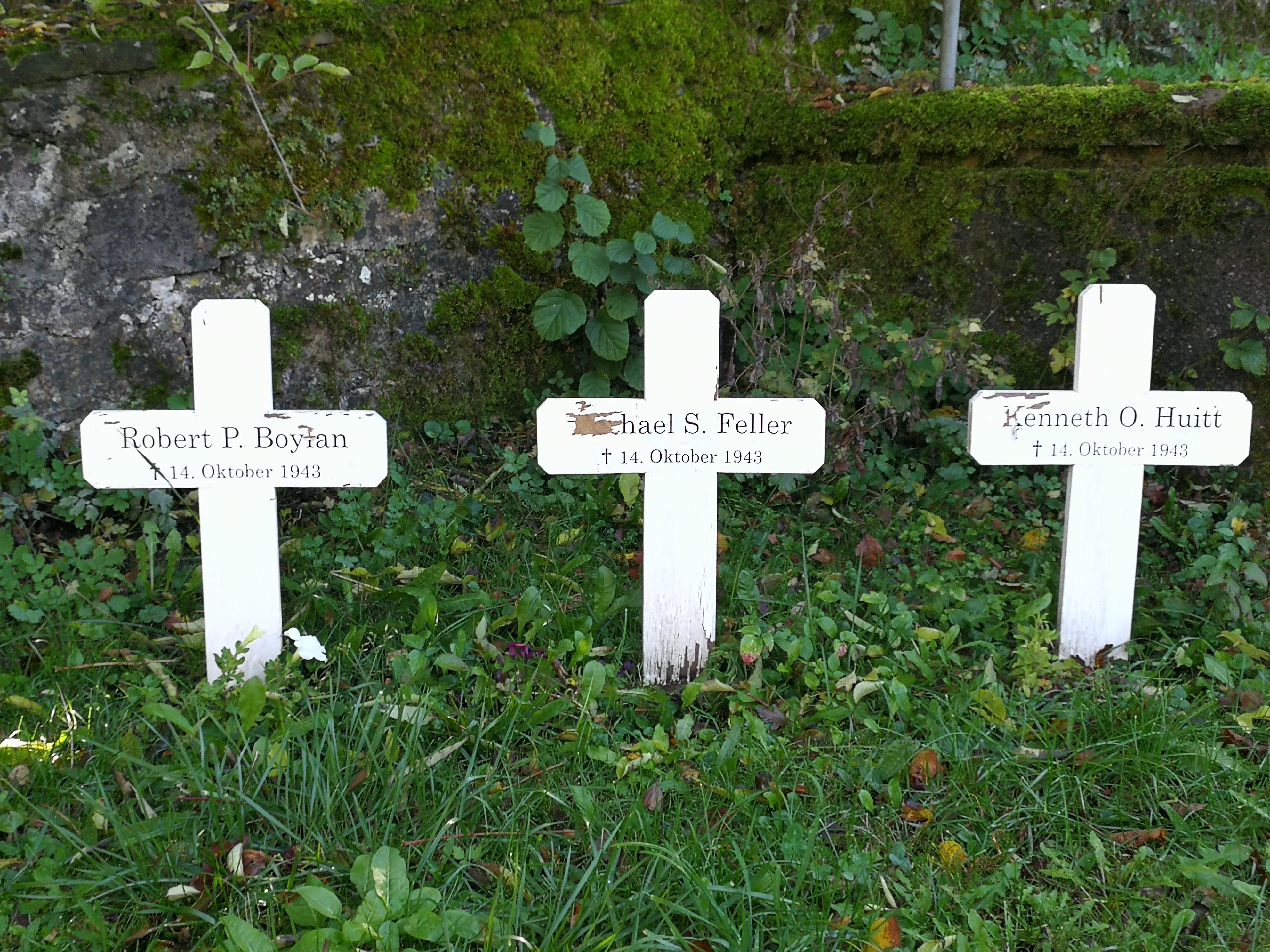
Robert Boylan was initially buried in Hausen cemetery. Photo Peter Boylan, October 14th 2019
The catholic priest of Hausen conducted a christian burial for the men in the cemetery of Hausen 1943. They were exhumed in the 1950s and sent to the Lorraine American Cemetery in St. Avold, France for identification and reburial.
Clan OBoylan thanks Rita Steger-Frühwacht, chairwoman of the historical society of Hausen for caring for commemorative crosses of Robert Patrick Boylan, Michael S. Feller and Kenneth O. Huitt. During the 2015 visit of Gus Yorbas son Tony, Mrs. Steger lead a touching prayer for all of the victims of war and for the three aviators in particular.
It is a coincidence that 60 aircraft were lost on first Schweinfurt and 60 more on the second Schweinfurt mission, but due to the lower number of aircraft participating on Second Schweinfurt, the loss rate calculates to an unsustainable 26%. Additionally, 120 of the returning aircraft were damaged, 17 of these beyond repair, so they became hangar queens, used to cannibalize parts to fix the others.
The losses were so high on the second Schweinfurt Raid that General Ira Eaker seriously considered switching the USAAF over to night time bombing like the British Air Force. The USAAF did not have control of the air over Schweinfurt at the time. Deep bombing penetrations of Germany were cancelled until the spring of 1944 when the new P51s (Cadillac of the Sky) were able to provide day time air cover for B17 raids all the way to Berlin and back. See Schweinfurt Raid Video 3. The dominance of the P51s later made it possible to dismount B17 chin and ball turrets because they were no longer needed. This saved fuel and increased both the speed and the range of the Fortresses - to the disadvantage of Berlin.
Although the other bomb groups suffered dreadful losses on Second Schweinfurt, ironically Robert Boylan was on the only aircraft lost on that October 14th 1943 by whole 381st BG. (The losses of the 305th BG were much higher. According to George C. Kuhl, Lieutenant Pelegrini said to Lt. Col McGehee:
Sir, we are the only ones left.) This is why October 14th 1943 was called Black Thursday .
Note: Many thanks go to my friend Norbert Vollmann who provided valuable information from the German side about Robert P. Boylans demise in Hausen. See Norberts pics and ballad about the B17-F Iron Maiden of the 379 BS that crash landed in Norberts back yard near Gerolzhofen/Schweinfurt on October 14th 1943. His point is: Were still alive!
Should you ever visit the area of Schweinfurt, we recommend using the following establishments as base camp:
http://www.bad-sennfeld.de/ Sit in the public room of the chalet near Sennfeld where the crew was interrogated after being caught.
https://www.brauerei-martin.de/ Run by Ulrich Martin right in the middle of Hausen - between the cemetery and the crash site. Try the Spezial Bier and the daily lunch special . Say hi to Masterbrewer Martin when you see him.